Oxford
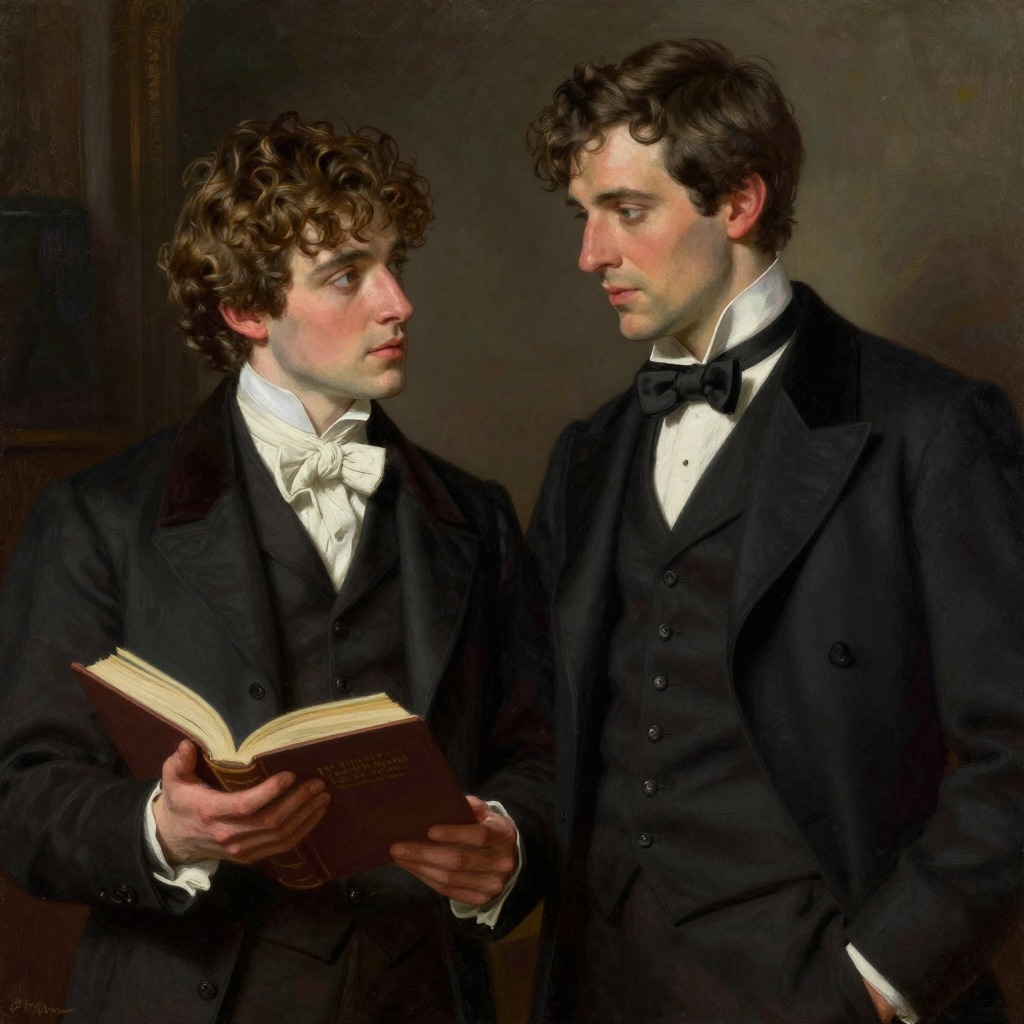
Oxford is the university city where Basil Hallward and Lord Henry Wotton first became friends, and it functions in the novel as a touchstone for the intellectual and emotional formation they underwent before the story's main events. The friendship that began there provides the foundation for the novel's central relationships: it is because of their Oxford connection that Basil introduces Lord Henry to Dorian Gray, setting the entire tragedy in motion. Basil's recollection of his Oxford days also reveals the depth of his artistic and personal devotion, while Lord Henry's memories of the same period underscore the divergence between his own cynical detachment and Basil's earnest passion.
Friendship and Formation at Oxford
Basil Hallward and Lord Henry Wotton met at Oxford, and their friendship there is the basis for their ongoing relationship in London. When Basil first describes his meeting with Dorian Gray, he contrasts his earlier independence—"My father destined me for the army. I insisted on going to Oxford"—with the overwhelming influence Dorian later exerts over him. Oxford represents for Basil a time of self-determination and artistic growth, before he encountered the personality that would absorb his whole nature, soul, and art. Lord Henry, for his part, recalls Basil's Oxford mannerisms with affectionate mockery: Basil's habit of "tossing his head back in that odd way that used to make his friends laugh at him at Oxford" is noted when Basil refuses to exhibit the portrait. The shared Oxford past gives their banter an intimacy that persists even as their values diverge.
The Confession of Idolatry
The most significant Oxford reference occurs when Basil Hallward confesses to Dorian Gray the true nature of his feelings. In a moment of emotional crisis, Basil admits that he has "worshipped" Dorian "with far more romance of feeling than a man usually gives to a friend." He explains that he had "never loved a woman" and that from the moment he met Dorian, his personality exerted "the most extraordinary influence" over him. Basil's confession is framed by his Oxford education: he speaks of his jealousy, his desire to have Dorian entirely to himself, and his fear that the portrait would reveal his secret. The confession is a direct echo of the romantic intensity that Oxford itself once represented for him—a place where he had been "my own master" before Dorian's arrival. The scene is charged with the pathos of a man who has transferred his youthful capacity for devotion from art and friendship to an idolatry that can never be requited.
The Poisonous Book and Oxford's Legacy
Dorian Gray's own intellectual development is shaped by a book Lord Henry gives him—a novel without a plot, a psychological study of a young Parisian who seeks to experience all passions and modes of thought. Dorian procures five large-paper copies of the first edition and has them bound in different colors to suit his moods. The book becomes a "prefiguring type of himself," and he reads it with "an almost cruel joy." This literary influence is a direct consequence of Lord Henry's Oxford-bred philosophy: the idea that life should be treated as an art form, that experience is its own justification, and that conventional morality is a hindrance. Oxford, in this sense, is not merely a setting but the intellectual seedbed for the hedonistic doctrines that Lord Henry propagates and that Dorian adopts.
The Contrast Between Oxford Ideals and London Corruption
Oxford also serves as a moral and aesthetic benchmark against which the characters' later lives are measured. Basil Hallward, who remains the most principled of the three, is described as having "the true refinement and perfect delicacy that come only from strength"—qualities that his Oxford education helped cultivate. Lord Henry, by contrast, uses his Oxford-honed wit to dismantle every moral certainty, declaring that "the only thing worse than being talked about is not being talked about" and that "conscience is the trade-name of the firm." The novel's tragedy is that Dorian, who might have been shaped by Oxford's ideals of beauty and truth, instead falls under the influence of Lord Henry's corrosive cynicism. When Dorian finally murders Basil, he does so in a locked room that once served as his childhood study—a space that, like Oxford itself, represents a lost innocence that can never be recovered.